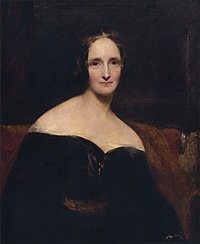
Mary Wollstonecraft Shelley (1797-1851) is by far best known for her legendary 1818 novel, Frankenstein, Or: The Modern Prometheus, in which she essentially invented the genre of science fiction. Married, at the time, to the Romantic poet Percy Bysshe Shelley (who purpled up the prose of Frankenstein quite a bit), she famously came up with the idea for the story for a ghost-story competition during "Year Without a Summer" between her, Percy, Lord Byron, Mary's step-sister and Byron's lover Claire Clairmont, and John William Polidori, and wouldn't you have liked to be a fly on the wall for that gathering. She went on to write several other novel, travelogues, and biographies and appears to have been rather a political radical, possibly influenced by the works (if not the specific ideas) of her father, anarchistic philosopher William Godwin, and her mother, noted women's rights activist and philosopher Mary Wollstonecraft (whom Mary Shelley herself never knew).
Herbert George "H. G. " Wells (1866-1946) wrote on a number of subjects, but became legendary for his pioneering work in science fiction. He didn't invent the genre, but he did help refine it into the form we now know. He held strong socialist and pacifist views that he worked into his books, especially in his later years when he primarily wrote social commentary in various forms.
The Time Machine
In which an unnamed time traveler travels in time with his time machine to the far future, and observes what has become of the human race.

 Volume One, Letters I to IV:


