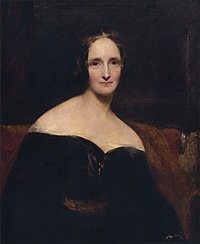
Mary Wollstonecraft Shelley (1797-1851) is by far best known for her legendary 1818 novel, Frankenstein, Or: The Modern Prometheus, in which she essentially invented the genre of science fiction. Married, at the time, to the Romantic poet Percy Bysshe Shelley (who purpled up the prose of Frankenstein quite a bit), she famously came up with the idea for the story for a ghost-story competition during "Year Without a Summer" between her, Percy, Lord Byron, Mary's step-sister and Byron's lover Claire Clairmont, and John William Polidori, and wouldn't you have liked to be a fly on the wall for that gathering. She went on to write several other novel, travelogues, and biographies and appears to have been rather a political radical, possibly influenced by the works (if not the specific ideas) of her father, anarchistic philosopher William Godwin, and her mother, noted women's rights activist and philosopher Mary Wollstonecraft (whom Mary Shelley herself never knew).
Jules Verne's Le tour du monde en quatre-vingts jours, variously published in English as Tour of the World in Eighty Days, The Tour of the World in Eighty Days, Round the World in Eighty Days, or using "80" instead of "Eighty," before finally settling on Around the World in Eighty Days, was published in 1873 at a time when technological revolutions such as the USA's Transcontinental Railroad, the Suez Canal, and the unification of the various railways crossing the Indian subcontinent made circumnavigation possible for the first time for the fairly casual traveler. In it, overly reserved Englishman Phileas Fogg and his new French servant Passepartout undertake the titular journey on a bet, while being pursued by Detective Fix, convinced that Fogg is a notorious bank robber. It does not contain any hot-air balloons.

 Volume One, Letters I to IV:

